I started this blog on February 4, 2005; I'm closing it up today, May 8, 2016. The posts here will live on, but all future writing will happen at the new blog that now lives on my newly redesigned website:
http://www.cherylklein.com/blog/
Please point any remaining bookmarks over there. I also have a new monthly newsletter that contains many blog-like elements; to sign up for it, see the front page of cherylklein.com.
This blog, and the readers who paid attention here, encouraged me to build the original version of my website, which led in turn to both of my books; and thus I can honestly say that the blog and you all truly changed my life. Thank you, everyone, very much.
Sunday, May 08, 2016
The End of an Era

Wednesday, February 17, 2016
THE MAGIC WORDS Cover!

Isn't it lovely? You can preorder it now in advance of its release on September 6, 2016. Details on my website here.
Monday, October 12, 2015
Two New Writing Workshops with Me!
I'm delighted to announce that on Saturday, November 21, I'll be teaching two writing workshops as a fundraiser for Park Slope United Methodist Church. One will be in the morning (9 a.m.-12 p.m.) and one in the afternoon (2-5 p.m.) at the church in Park Slope, Brooklyn. Each one is $50, and all proceeds go to PSUMC. (This will be the first public debut of some material from my new book, The Magic Words, and I'm excited about that.)
"So You Want to Write a Book?" (9-12): In this workshop for beginning writers, or even people with just an idea for a book, "We’ll talk about practical techniques for starting and sustaining a novel-length narrative, including questions to ask, story dynamics to explore, and tips and tricks for getting the work done. A brief overview of revision and submission practices and publication options will be provided at the end."
To sign up: https://www.eventbrite.com/e/so-you-want-to-write-a-book-tickets-18955014960
"A Master Class in Character" (2-5): "What makes a character come alive on the page? What details should you include, or not include? Do characters have to be likeable or relateable? If you want a character to be relateable, how do you make that happen? In this workshop for novelists, we’ll explore the many dimensions and mysteries of characterization, and discuss ways to create believable, compelling fictional people."
To sign up: https://www.eventbrite.com/e/a-master-class-in-character-tickets-18955102221
It would be great to see you there! If you have any questions, leave 'em in the comments. Thank you for your interest.
Saturday, October 10, 2015
Five Questions for Emil Sher, author of YOUNG MAN WITH CAMERA

This debut novel by Emil Sher is quite honestly one of the most extraordinary and challenging books I've ever worked on--an incredible example of voice; a narrative that will ask you to think about the interplay between language and images, what you expect from a narrative, what makes a good ending in books and in life. It came over the transom to my colleague Anne Shone of Scholastic Canada, who shared it with me, and is illustrated throughout with richly evocative black-and-white photos. This past week, it was nominated for Canada's Governor General's Award -- their equivalent of the National Book Award.
Without further ado, Five Questions for Emil:
1. Tell us a little bit about your book.
At first blush, Young Man with Camera is about bullying. But as T— would likely ask: “What about the second blush?” At its core, I believe this novel is about a lifelong friendship between T— and Sean that is tested in ways that reveal the breadth and depth of their bond. It’s also about a blossoming friendship between T— and a homeless woman named Lucy that is cut short. T— values both relationships, and both are brought into sharp relief at the hands of Ryan, who is not simply a garden-variety bully: he’s a dyed-in-the-wool psychopath. T— has long been in the crosshairs of "Joined at the Hip," his name for Ryan and the minions who have tormented him ever since a kitchen fire accident left him with facial burns. His perch on the margins gives T— a singular perspective that he captures in striking black-and-white photographs. When he bears witness to an assault, camera in hand, he is forced to make some very difficult, life-changing decisions. To keep silent is to bury the truth. To speak out is to put the lives of loved ones at risk. For a young man who hungers for the truth, T— moves forward by being true to himself.
2. If this book had a spirit animal or theme song, what would it be and why?
In a world of tortoises and hares, it’s a tortoise that would feel most at home between the covers of this book. Tortoises often go unnoticed; they slowly make their way beneath the radar, so to speak, with none of the eye-catching speed of a hare. I think T— would feel a kinship with a tortoise. They may not make a move for a long time but you can practically hear their thoughts tumbling inside. And like a tortoise, T— needs a protective shell of his own as he navigates the bruising bumps of life.
And while I don’t know if T— would ever finding himself listening to Stephen Sondheim’s "Send in the Clowns," I do know it would resonate with him. Listen to it once and you would think it’s about a trapeze artist who has lost her timing. But, in fact, she is speaking of a whole other loss altogether that has nothing to do with circuses and clowns. There’s what you hear and then there’s what is actually being said. Just as there’s more than meets the eye in a photograph, this song takes on a very different meaning when placed in a larger context. Context, as T— believes, is a synonym for the larger truth. In that way, "Send in the Clowns" is of a piece with T—‘s world: there’s more to it than meets the ear.
3. Please name and elaborate on at least one thing you learned or discovered about writing in the course of creating this book.
It is sometimes said that “Character is plot,” which I believe to be true to the extent that I have long been drawn to stories anchored by compelling, complex characters. But a memorable protagonist doesn’t necessarily mean that the story will engage and keep us connected from start to finish. And so it was with T—, who I took a shining to from the get-go but whose motivations and intentions and reactions and decisions all had to be cracked open and justified and structured so they moved the story forward. One of my favorite photographs in Young Man with Camera (artfully shot by David Wyman) is of a bicycle half-buried in snow. “It makes me think of a story that ends before it’s over,” says T—. “There’s no And then.” No matter how rich and varied characters may be, they need an “And then….”
4. What is your favorite scene in the book?
There are three moments in the novel that have stayed with me, and they are all linked to friendship. There is the scene early in the story when Ruby appears from the back of her father’s store with a paper towel she offers to T—. It’s a lovely gesture, made all the lovelier because of the loveless humiliation we know T— has just endured at the hands of Joined at the Hip.
T— is not accustomed to a lot of physical contact, other than being tripped and shoved, which makes what Lucy does all the more meaningful. During the scene where they look at a photograph together — "Girl with Striped Face" — Lucy reaches out and gently touches T— ’s scars, without judgment.
T— and Sean have long shared the same boat. We learn that boat is made from different stuff when T— describes the importance, the necessity of being by his best friend’s side as Sean wades through some very difficult waters: “If there’s something you really don’t want to do, it helps to have someone help you not do it. Not right away. Not for a while. Not until you’re ready.”
5. What are you working on now?
Is it premature to share a working title? Unexpected: a fish-out-of-water story about a seventeen-year-old single father.
Thursday, August 20, 2015
This Is My Brain on Revising
(with my book due to my editor in fewer than two weeks)
SJKD;FIEWBNTBISLndjkfilgWEYGTBEHWYGF832G353BSJDKFNVIUNIo47brtntrlbyt23f5lbdishiuetblb t84295GAIUBFSEWG weuhi4b5laytbwoty4gbqtklhbglayeg8o8blef KBEDFIWEYRL
. . . That is actually a lie, but it was fun to write. My brain is tired but present, and mostly orderly. I have an entire edited ms. before me, with separate lists of things I need to do to implement said edits; I only need time to carry them out. I may not have enough time to carry them all out, and this distresses me extremely; but I will do the best I can, which is all anyone can do, and trust I'll get to revise it better still later. Onward! Or better: Excelsior!
Friday, July 03, 2015
A Verbal Venn Diagram of My Summer 2015 List
All of the books on my Summer 2015 list have five things in common:
- Friendship!
- Diversity!
- Strong Female Characters!
- Multiple starred reviews!
- They're out now!

by Bill Konigsberg
The author of Openly Straight returns with an epic road trip involving family history, gay history, the girlfriend our hero can't have, the grandfather he never knew, and the very prickly Porcupine of Truth.
The friends: Carson Smith, Aisha Stinson
Shared traits with other books on this list: Young adult; wildlife (symbolic); road trip; mystery; Internet searches; city setting (Billings, Salt Lake, and San Francisco); family
Distinct traits: Contemplation of religion and God; improv comedy

by Cherie Priest
Art by Kali Ciesmeier
The friends: May (a writer in glasses), Libby (a glamorous artist, until she drowns ... and then maybe after)
Shared traits: Young adult; mystery; Internet searching; street art; chase scene; fight scene; city setting (Seattle); fairy tale elements; YA debut of an adult author; ghosts; interior art; biracial main character
Distinct traits: Hackers; printed in purple

by Megan Morrison
You know the hair, the tower, and the witch. But in the land of Tyme, that's just the start of the story . . .
The friends: Rapunzel, of the tower, and Jack, of beanstalk fame
Shared traits: wildlife (actual -- a frog); royalty; road trip; a chase scene; a fight scene; fairy tale elements; magic; over-the-transom submission (of sorts); big hair
Distinct traits: Middle grade; debut novel

by Kate Beaton
Shared traits: wildlife (actual); fight scene; biracial main character; interior art
Distinct traits: Picture book; castles; sweaters; farting

by Daniel Jose Older
Paint a mural. Start a battle. Change the world.
The friends: Sierra has an awesome group at her back: Bennie, Izzy, Tee, and Big Jerome
Shared traits: Young adult; street art; chase scene; city setting (Brooklyn); mystery; Internet searching; family; fight scenes; magic; YA debut of an adult author; ghosts; over-the-transom submission; big hair
Distinct traits: A completely heretofore-unseen form of magic in fantasy, deeply connected to its heroine's culture and imagination; a sweet and hot romance; tattoos
Thank you for checking these books out!
Monday, May 25, 2015
Behind the Book AND Five Questions for Megan Morrison, author of GROUNDED: THE ADVENTURES OF RAPUNZEL
Megan Morrison and I met in 2003, via our mutual friend Melissa Anelli of the Harry Potter fan site The Leaky Cauldron, and I read an early draft of Grounded in 2004. I liked its characters and action a lot -- Rapunzel descending from her tower against her will, and traveling across the land of Tyme with a thief named Jack -- but to my eye, it didn't have enough emotional and world-building depth to elevate it from "cute and smart" to "real and meaningful," and I thought Meg could do more with it. So I told her that, in a three-page editorial letter, and offered to look at a revision when she was ready.
I did not think at the time--and nor did Meg--that this readiness would take eight years. But when she contacted me about the ms. again in 2012, she said that she had rewritten the book, "revised the rewrite, plotted the entire series in detail from back to front, and then revised it again. . . . Though the plot sounds similar to what it was, the book is very different, with a cast of characters who are fully realized and motivated, including the peripheral characters, who don't come to the fore until later books in the series. I love it and believe in it." I had never forgotten Grounded--and in fact had been hoping for this e-mail for eight years--so I asked to see it again.
And this time, I loved it and believed in it too, as Meg was 100% right in her estimation of her revised novel. I adore fairy tales in part because the transformations they contain speak to some of our deepest human stories and relationships, and my favorite retellings round out those transformations with complex psychology and world-building, while honoring the readerly pleasures of wonder or romance or connection at their heart. The new Grounded kept all the charm of Rapunzel and Jack's banter and the cleverness of the land of Tyme, whose history, geography, and even the resulting economics and sociology have all been fully thought through. But it achieved the reality and deeper meaning I'd been hoping for, thanks to Rapunzel's complex relationship with her Witch, whom she truly loves, and who has good reason to keep her in the tower; and Rapunzel's own process of growing up, finding out hard truths, and yet moving forward into wholeness. The book made me laugh, it made me cry, it made me intensely happy as a reader; and since it came out earlier this month, both Meg and I have been delighted by its critical reception -- including two starred reviews! -- which has praised both its many pleasures and that emotional depth. (It's also an Amazon.com Best Book of the Month for May.) Publishing it has reminded me yet again: Good things come to editors who wait.
Four more notes, before I share Meg's Five Questions:
- You can actually see a rare scene of the editor and author at work, sort of, in Melissa Anelli's Harry, A History. Page 79 documents a writing weekend among the three of us that took place at my apartment, where Meg was working on Grounded, Melissa was writing for the Leaky Cauldron, and I was editing A Curse Dark as Gold by Elizabeth Bunce, another great fairy-tale retelling. (And also making pancakes.)
- This entire series of five-question posts was actually inspired by Meg herself, as she's written "Five Reasons to Read _________" posts like this one on her blog for years.
- Meg wrote about her side of this story at Literary Rambles and in this interview, which also reflects on her experience as a Harry Potter fan and a fanfiction author.
- And Meg and her friend Kristin Brown, who's a professional geographer, talk about their collaboration in creating "plausible geography" for Tyme in this fascinating interview.
Five Questions for Megan Morrison
1. Tell us a little bit about your book.
It’s the story of Rapunzel – the hair, the tower, the witch – except that my Rapunzel loves her tower and doesn’t want to leave it. She has everything she wants and thinks she is the luckiest person in the world. Until things go wrong, and she learns otherwise.
2. If this book had a theme song and/or a spirit animal, what would it be and why?
I actually have a whole playlist for Grounded. It’s here on Spotify.
If I were to choose just one song, it would have to be “Ain’t No Mountain High Enough” (Marvin Gaye and Tammi Terrell). This is Witch’s promise to Rapunzel: that she will allow nothing to divide them – that she’ll rescue her from anything. It’s a very different song at the beginning of the book than it is at the end.
3. Please name and elaborate upon at least one thing you learned or discovered about writing in the course of creating this book.
Sometimes, the idea for a story will come before the writer is ready to meet it. That doesn’t mean that the writer should stop writing or give up on the idea, but it means that the story won’t mature until the writer does. I had the idea for Grounded long before I was equipped to write it well. Life experiences – in particular becoming a mother and a teacher – were necessary. Not that those particular experiences are prerequisites for writing. Far from it. They were just necessary for me. They changed me in big, important ways, and strengthened me as both a storyteller and as a professional. My work ethic and my openness to criticism are vastly improved over what they were ten years ago. I have hardened and mellowed both, in the ways that I needed to.
4. What is your favorite scene in the book?
Rapunzel’s conversation with Witch at the end.
That’s a hard question, though. Whenever Rapunzel and Jack are talking to each other, I am delighted.
5. What are you working on now?
The second book in the Tyme series! A different fairy tale, set in the same world. Many characters who appear in Grounded will show up again.
Tuesday, March 31, 2015
Five Questions for Lindsay Eyre, author of THE BEST FRIEND BATTLE

1. Tell us a little bit about your book.
Sylvie Scruggs is the heroine of this series, and she’s a lot like her name: interesting, energetic, and a little rough around the edges. In The Best Friend Battle, Sylvie comes home from a family vacation to find that her best friend, Miranda, has made friends with the enemy, Georgie Diaz. Sylvie’s entire world is threatened by this new friendship, and she does everything she can to get things back to normal. But normal doesn’t come easily, and Sylvie seems to have a penchant for making difficult situations much, much worse!
2. If this book had a theme song and/or spirit animal, what would it be and why?
Sylvie’s theme song would probably be "Life’s a Happy Song" from the new Muppet movie. It’s all about how life is a happy thing if and only if you have someone, a best friend, to share it with. But what happens when you don’t? (Sylvie does not want to find out.)
3. Please name and elaborate upon at least one thing you learned or discovered about writing in the course of creating this book.
Writing this book was not easy. I don’t believe (or at least I don’t like very much) writers who claim writing is an easy thing whether they are writing their first book or their hundredth, but certain things can make writing go much more smoothly. When you can hear the voice of your main character — when that person is large-as-life in your head — many difficult issues take care of themselves. Your writing struggles will revolve around plot, not plot and character. As flawed as Sylvie is, she’s now a friend I could sit down with and have a conversation about anything from mushrooms to ice dancing. That familiarity makes writing (mostly) a pleasure. I don’t always know what will happen to Sylvie or even what she will do, but I usually know what she would have to say about it!
4. What is your favorite scene in the book?
The scene where Josh and Sylvie build the castle together. I love Josh (who gets a big role in Sylvie’s third book) and all of his interactions with Sylvie.
5. What are you working on now?
Sylvie’s second adventure, The Mean Girl Meltdown, is in the final stages of publication [editor's note: out this fall!], and her third book, The Spelling Bee Scuffle, is in beginning stages of the editorial process. I’m also working on a novel about a twelve-year-old girl named Rory, the middle child in a dysfunctional and eccentric family, whose mother is in Sweden for a month. As Rory, a very different character than Sylvie, attempts to save the family from their dictatorial grandmother and an impending eviction, she alienates her best friend, Owen, nearly kills her younger brother, and gets her grandmother arrested for illegal possession of a motorcycle. This book has been much harder for me to write because of what I was speaking about earlier — knowing your characters. I get into the heads of many characters in Rory’s book, and I’m finding out very quickly that I know some of them much better than I know others!
Sunday, March 22, 2015
"The Way It Is," by William Stafford
There’s a thread you follow. It goes among
things that change. But it doesn’t change.
People wonder about what you are pursuing.
You have to explain about the thread.
But it is hard for others to see.
While you hold it you can’t get lost.
Tragedies happen; people get hurt
or die; and you suffer and get old.
Nothing you do can stop time’s unfolding.
You don’t ever let go of the thread.
Saturday, February 28, 2015
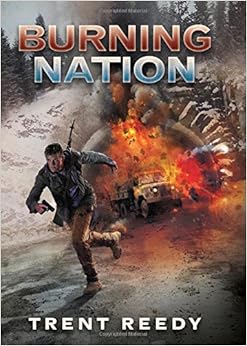
Five Questions for Trent Reedy, author of BURNING NATION
(The first in a new series of brief interviews with authors of forthcoming books)
1. Tell us a little bit about your book.
Burning Nation is the second book in the Divided We Fall trilogy. It continues the story of seventeen-year-old Idaho Army National Guardsman PFC Danny Wright and his friends as they are stuck in the middle of a tense stand-off between the state of Idaho and the federal government of the United States. In the first book, Divided We Fall, Idaho has voted to nullify the Federal Identification Card Act. When Danny’s National Guard unit is sent to quell a protest/riot resulting from this nullification, he accidentally fires his rifle, which causes other people to shoot, leaving twelve dead and nine wounded. The president demands an investigation and prosecution. The governor of Idaho refuses to cooperate, saying that he gave a lawful order to the National Guardsmen under his command.
Burning Nation begins right where the first book left off, with the president sending the military to force Idaho to comply with federal law. Right from the beginning, Danny and his friends are caught up in the fight, but as the country descends into the chaos of the Second American Civil War, losses begin to take their toll. It becomes hard to understand what has been won, but easy to see what’s been lost. As the sacrifices mount and betrayals abound, Danny and his friends begin to think about the wounds they’ve suffered, inside and out.
It’s an action-packed book that continues to explore what happens when America’s current political divide widens into tomorrow’s nightmare, and it’s alarming how many real-life headlines seem to have been predicted by Divided We Fall and Burning Nation.
2. If this book had a theme song, what would it be and why?
Ten years ago, when my fellow soldiers and I were serving in Farah Province in Afghanistan, we were struck by how much the landscape resembled that featured in the movie Mad Max: Beyond Thunderdome. That movie features a song by Tina Turner called "We Don’t Need Another Hero." My fellow soldiers would joke about this song, with one man saying, “We don’t need another hero” and another replying, “We don’t even know the way home.” The video is a bit dated and cheesy, but if you listen to the words, the song really fits as a commentary on the brutality and waste of war that is very appropriate for Burning Nation.
3. Please name and elaborate upon at least one thing you learned or discovered about writing in the course of creating this book.
When I began work on Burning Nation, I was under the naive assumption that writing the book would be easier because I had already finished Divided We Fall. I knew the characters, the setting, and at least the situation that led to the events in Burning Nation. I should have known that Burning Nation would be as significant if not a greater challenge than the first book. One of the challenges came from the situation the characters face. Throughout most of Burning Nation Danny and his friends must endure a federal military occupation of their small northern Idaho town. With U.S. soldiers hunting for them all the time, their movements, and thus my options for the kinds of scenes I could include, felt rather limited. I began to feel almost as claustrophobic as Danny and his fellow soldiers.
Another challenge with writing Burning Nation was that it was the second part of a story that already had its first part on the market. I was facing a situation that was new to me, that of having public feedback on characters and other aspects of the larger Divided We Fall story, while I was writing that story’s second installment. It felt like having many, sometimes too many, advisors in my office with me while I worked. Cheryl was wise, as she usually is, when she encouraged me to stop looking at reviews and reader comments as I worked on Burning Nation.
4. What is your favorite scene in the book?
I’m really quite happy with a lot of the scenes in Burning Nation, so I’m going to cheat and list two. First, since Burning Nation isn’t merely an action/war book, but is a piece which, I hope, encourages the reader to think about the terrible nature of war and its effects on those who live through it, I’d like to point out a scene that happens after Danny Wright has been through terrible physical and emotional torture. He is out of his mind from sleep deprivation and other torments, and when his one-time rival TJ bursts into his cell to rescue him, Danny isn’t sure if what is happening is even real. He’s confused and kind of cries, “Travis?” Travis Jones realizes that Danny is seriously messed up and it’s going to be harder to rescue him than he and his friends supposed. It’s a small moment, but I hope there’s a lot of emotion in that simple question, that exhausted and near-breaking-point, “Travis?”
And since I love some good action, I’m also quite happy with a hand-to-hand fight scene near the end of the book. It’s a fight between Danny and a U.S. Army major, a desperate fight to the death where Danny has to make an important decision about how deep into the war he’s willing to go, and how much of himself he wants to save. In addition to the moral question the fight raises, I just think it’s a clear scene, a tense and suspenseful fight. And the conclusion of the scene is really quite chilling.
5. What are you working on now?
I am hard at work on the third book in the Divided We Fall trilogy, entitled The Last Full Measure. The story follows America’s further final decline into a terrible civil war, and the difficult consequences this has for Danny Wright and his friends. I’m having lots of fun working on it, and it’s on schedule for a 2016 release.
For more about this book, including an excerpt, reviews, and purchase information, visit the Burning Nation page on the Arthur A. Levine Books website.
Subscribe to:
Posts (Atom)



 Posts
Posts


