Showing posts sorted by date for query Book Map. Sort by relevance Show all posts

Monday, December 12, 2011

Behind the Book: Three Things Writers Can Learn from Liar's Moon, Part III

Again: If you are here for the giveaway, scroll on down!
If you are here because you're interested in the $2.99 e-book of
StarCrossed, yay you! Click here for details about where to buy it.
And if you are here for writing craft stuff, read on.
 

3. Recognize the Power of a Damn Good Outline. 

As anyone who’s read Second Sight knows, I love a good outline (or a bookmap, as I call them there), and as pretty much all of my authors know, I am sort of insane about using them. That’s because an outline allows you both to see the action of an entire book laid out in just a few pages, and to break down how that action and the characters involved are developing scene by scene . . . what's changing, what’s not feeling necessary, what maybe should be added, how I as a reader am reacting to the characters and events as we go along. Sometimes I will ask authors to outline their book at the same time I’m doing it, and it’s always fascinating to compare what I as a reader am taking away from each chapter versus what they see in it.

Anyway, because the narrative structure of Liar’s Moon was so complex, I ended up outlining it in four different ways at various stages in the process, and I thought it might interest you all to see those various drafts. In the first one, my Basic Bookmap, I outlined the events in detail in the order in which they unfolded in the plot, in which Chapter 2 was described like this:
Ch. 2/11 – Durrel helps her clean up. He’s there because they think he murdered his wife Talth Ceid by a poison called Tincture of the Moon. Only people against him = Talth’s family. Account of murder night on p. 17. Raffin Taradyce has joined the Acolyte Guard. Someone has bailed Digger out, and she leaves. Durrel asks her to take a message to his father.
(The “11” was the page number on which the chapter started.) That helped me wrap my head around the basic events of the book, and I made notes in bullet points underneath or sometimes within those descriptions. The first draft of this outline is just for me, but later, after I’ve processed all my reactions to the book and determined what’s most necessary and helpful for an author to hear from me at this stage, I’ll often edit both the chapter descriptions and the notes and send this outline to the author as part of an editorial letter.

Once I had the whole book in my head this way, I broke this down into my second outline, a Mini-Map with just the key events of this chapter, to wit:
2 – meets Durrel, learns about murder of Talth
 A Mini-Map is useful for quick reference—answering questions like “Okay, now when did she find that dead body again?”—especially in long or plot-dense novels like this one.

The third version, the Plot Points Map: I went through and identified where each of the many mystery plots started, labeling it in bullet points and all caps under each chapter. Then I added any LIES told in the chapter, or any TRUTHS UNCOVERED, to help keep track of what Digger knew was true when; and polished it off with a SETS UP, so I knew what the reader was expecting to happen based on the action of this chapter, and I could be sure that the later action of the book followed up on that and paid it off. (I also sometimes added TO ADD if there was information we needed earlier, TO MOVE if something was going elsewhere, or TO CUT if something wasn’t feeling necessary.) That changed the look of this Chapter 2 outline to this:
2 – meets Durrel, learns about murder of Talth
    •    MYSTERY: Who killed Talth Ceid?
    •    LIES:  Durrel says that he doesn’t know how the poison got into his room
    •    SETS UP:  expectation that Digger will go by Charicaux and talk to Ragn
    •    UNDERSTOOD THREAT & MOTIVATION:  The Ceid are out for Durrel’s blood in revenge for Talth’s death.
Finally, because this is a mystery novel, and mysteries move forward in part by digging backward, I created a chronological list of events that started a couple of years before the action of this book began—before the murder was even committed, in fact. This “Backwards Outline” chronicled all of the complex series of events leading up to the murder, and also narrated the events of the night of the murder itself. That way we could be sure that the backstory structure was sound by seeing that all of its events were there; and once that backstory structure was in place, and events arrived at the point at which the action of the book actually began, we could concentrate on when to reveal those backstory events in the frontstory for maximum effect. While revealing any of that backstory would be spoiling you for the reveals in the book itself, here’s where the action picks up with the book’s beginning:
 

TWO MONTHS LATER (when the book begins)
    31.    (Ch. 1) Digger, pickpocketing, is roughed up and arrested by the King’s guards.
    32.    Taken to the King’s Keep, she is thrown into Durrel’s cell and (2) they talk about the murder.
             a.    MYSTERY:  Who killed Talth Ceid?
    33.    Digger’s friend Rat bails her out (courtesy of a note attached to 50 crowns) and she leaves the Keep.
             a.    MYSTERY:  Who sent the note to bail Digger out? And if this was arranged on Durrel’s behalf, who got her sent there in the first place?
    34.    (3) Digger asks Rat to track the paper of the note. (4) She decides she will investigate the murder.
             a.    Digger’s belief:  Durrel is innocent; no idea about other suspects.
    35.    Digger goes to Bal Marse and finds it abandoned and empty, but with traces of magic about.
             a.    MYSTERY:  How is Talth tied to magic?
Here, you can see, I started numbering the events so that it was easy to refer to them later—for instance, later in the outline, after Talth’s murderer was revealed, I noted in the outline that that SOLVED MYSTERY 32a. Such a strategy helped me keep track of all the plot threads flying in the wind and making sure there weren’t any loose ends we didn’t intend to leave dangling. (Some we intended.) And when Elizabeth and I were having editorial conversations about the book, it was very easy to say, “Okay, so let’s move events 45-49 to Chapter 8 so that we don’t reveal that information too early in the process.” If I can speak as a proud editor for a moment, the fact that I could make a Backwards Outline for this book is precisely what makes Elizabeth such a great writer: how densely and completely she’s imagined and written the world she’s created, and how well she brings it to life. 


Lesson for Writers:  I am completely agnostic on whether writers should outline their books before they do a first draft: That’s up to the writer and their working style and their relationships with their stories and characters. But once that first draft is done, do consider making an outline like one of the ones above, tailored to your own manuscript’s needs, to help you see the book afresh in both its component pieces and as a whole.

And did all this work on Liar’s Moon pay off? Well, check out these reviews:
  • Leila Roy at Bookshelves of Doom and Kirkus Reviews: "The first time through, you’ll concentrate on figuring out the world and meeting the characters and following the story. But when you read them again, you’ll notice how multilayered they are. You’ll notice hints and subtleties of character and plot, and you’ll notice just how carefully they are crafted. You’ll notice that the characters are fully realized people—so much so that it’s easy to forget that they’re fictional creations, even if they do live in a world with three moons."
  • Publishers’ Weekly Children’s Bookshelf Galley Pick of the Week: "It's a very versatile story—perfect for a display of mysteries, fantasy, adventure, or novels with powerful heroines. Liar’s Moon will definitely be one of my very favorite handsells for the fall and holiday seasons, particularly for my fans of Patricia Wrede, Kristin Cashore, Tamora Pierce, and Megan Whalen Turner."
  • VOYA: “As with StarCrossed, Bunce excels in weaving together several plot points and characters without weighing down the novel. Fan of [Kristin] Cashore’s Graceling will greatly enjoy Digger’s unique voice and strength of character, along with Bunce’s ability to fully immerse readers in a finely crafted world.  This book, along with its prequel, should be on most library shelves as both have a wide appeal….”
+++++

The Giveaway Runs Through Midnight Wednesday!

I wrote earlier about the terrific deal we’re offering on the digital version of StarCrossed, which continues through the end of the month. But there is no time like the present to get the word out about it! To that end, I’m having a giveaway here, with the chance to win a signed hardcover set of BOTH StarCrossed and Liar’s Moon, OR a signed paperback copy of my Second Sight . . . and I’m offering five prizes in total, so your odds are very good! To enter:

If you’re on Twitter, retweet this message between now and 11:59 p.m. next Wednesday, December 14:
Elizabeth Bunce’s STARCROSSED is now $2.99 on e-book—RT for the chance to win a hardcover + LIAR'S MOON! http://bit.ly/uNZiKv @chavelaque
Or you can post about this on your blog or LJ (with a link back to this blog post) and leave the link to your post in the comments below, also by 11:59 p.m. EST on Wednesday the 14th. Or both! Each individual tweet or blog post counts as a new entry, so each one increases your chances. (They’re like tesserae in the Hunger Games!) (A link on Twitter to YOUR blog post does not count toward the giveaway, though.) Once all the comments and RTs are in, I’ll pick three names out of a hat and announce the winner on the 16th.

So to do this legal-style:
  1. How to Enter via Twitter: Using your Twitter account, follow @chavelaque and then re-tweet my original tweet of “Elizabeth Bunce’s STARCROSSED is now $2.99 on e-book—RT for the chance to win a hardcover + LIAR'S MOON! http://bit.ly/uNZiKv @chavelaque” Please note that the phrase “@chavelaque” MUST be in your message or your entry will not be counted. Tweets must be retweeted between 12/7/11, 9 am EST and 12/14/11, 11:59 pm EST (the “Entry Period”). You can tweet as many times as you like in the Entry Period.
  2. How to Enter via Blog/LJ: Post about the $2.99 sale or this giveaway on your blog or unlocked LJ, then leave a link to your post in the comments below. Your post MUST include a link to this post. Also, you MUST leave your own link in the comments on this post between 12/7/11, 9 am EST and 12/14/11, 11:59 pm EST or your entry will not be counted. Post as many times as you like during the Entry Period.
  3. The Prizes: Three (3) winners will each receive one (1) hardcover copy of both StarCrossed and Liar’s Moon (Approximate Retail Value $35.98). Two (2) winners will each receive (1) copy of Second Sight (Approximate Retail Value $16.99). Everyone will receive my undying gratitude.
Thank you for participating, and I hope you win!

Saturday, October 09, 2010

Q&A: Elizabeth C. Bunce, author of STARCROSSED

What were the initial seeds of StarCrossed? How long had the book been growing for you before you started writing it?
A long time! I started drafting the manuscript right after submitting A Curse Dark as Gold to you, in the fall of 2005. But I first heard Digger’s voice whispering to me more than ten years ago, when she was the main character in an adult novella that never went anywhere. And the seeds of her world and her story were much older still. Digger inhabits a fantasy world I’ve been tinkering with since I was a teenager, back when I first realized I wanted to write.

I can’t remember exactly what made me realize that my shiftless novella could be a much better young adult novel, but I do clearly remember deciding that StarCrossed would be the book to follow Curse. I was coming off three very intense years inside Charlotte Miller’s head, and I was eager to kind of shed that skin and work with a new character, a new voice—and especially work on a book that could be potentially lighter in tone. I remember telling my agent that I wanted to write A Fun Book, because as enormously proud of Curse as I am, and as rewarding as it was to write, “nobody could accuse it of being rollicking.” My agent responded, “Yeah, it’s not a romp.”

As it happened, my idea of A Fun Book apparently involved the main character’s lover being murdered by secret police on Page 1, so clearly my Fun Meter still needs some calibrating!

A Curse Dark as Gold was loosely based in the historical real world and on the fairy tale “Rumpelstiltskin.” How did it feel to create a wholly original world and storyline here? (I wonder if you even felt more free, not having to get those historical details right . . . ?)
Going about creating a new world was not so different—but working without a plot net (without the framework of a fairytale to guide my storyline) was definitely a little intimidating. This is the first novel I’ve completed that is not a retelling of some sort. On the one hand, that was nerve-wracking, but at the same time it was also very freeing. Since I wasn’t constrained to a predetermined set of plot points and conclusion, I never felt like I was “forcing” my characters into position, and they were able to go about their business quite naturally. As long as I could keep up with them, we did fine!

Even though this is a made-up world, I still did my homework, familiarizing myself with everything from lunar science, to castle life, to the tools of historical espionage, to our own world’s history of religious persecution, to period firearms and the technology of warfare! There was a little more freedom here, however, for a couple of reasons. First, Llyvraneth is not so firmly grounded in real-life Earth history as was the world of Curse, so I could focus on the details that served the story best, without concern about anachronisms or inaccuracies. But more than that, Digger herself was a much more impatient character than Charlotte, and tended to pull me away from the research to tell my story, already! a lot sooner than Charlotte ever did.

What sorts of reference materials did you make up to help keep track of the world?
Since I’ve been working with Llyvraneth for more than twenty years, I didn’t need much for my own reference (aside from a map), but a critique partner requested a glossary and cast list (which became the Lexicon included in the published book), and you asked me for at least a couple of documents to help flesh out the worldbuilding. If I recall correctly, one was a timeline of the political history that feeds StarCrossed's crucial backstory; and the other was an account of Llyvrin/Celyst mythology, chronicling the lives and characters of the seven gods worshipped by Llyvrins. These documents were wonderful fun to come up with, and I really enjoyed drawing on all those years of worldbuilding!

One kind of amazing thing happened during the revision process. I ran out of printer paper while printing out a set of your editorial notes, and I had to go digging around the dark recesses of my office to find something, anything that would run through my printer. I ended up with a pack of typing paper from my college word-processor days. When I actually went through and read the printed notes, I discovered that I’d printed a page on top of a hand-drawn map of Llyvraneth I’d done years and years before!

Many writers talk about having a markedly different emotional experience writing a second novel after the first has been published . . . either that it’s easier, because they know that they can finish a book and they’ll have some support, or harder, because of new concerns about expectations. What was your experience this time around? And did your writing process change at all with this book?
To be honest, I really don’t know what my writing process is anymore, because it’s been so different on all two-point-seven-five books! Curse took three years of painstaking craft and research, with six months of revision after the sale. StarCrossed and Liar’s Moon both sold on proposal, so I was already on deadline when I wrote them. StarCrossed happened in big chunks between bits of Curse, then was revised on a crazy, oft-disrupted schedule, which I’m sure you remember well and which I believe we are both sworn never to speak of again!  For Liar’s Moon I did extensive advance plotting, outlining, and preparation before I ever wrote a single word—and then had a solid first draft in just over three months. I’m kind of looking forward to the next projects, to see how else my process evolves, or if it ever settles down into something that I can point to and say, “this works.”

As for the emotional experience? Wow. So, so different. Leaving aside the schedule and deadline, it took me ages to understand that StarCrossed is, in fact, a vastly more complicated story than Curse, which has essentially a single, straightforward plotline. StarCrossed has something like five intertwining mystery plots that must all be resolved in order, in order to achieve Digger’s emotional and thematic development. Realizing this was a turning point for me with the manuscript.

But more than that, there was this odd, award-shaped shadow over the writing of this book that made it much more difficult than I ever anticipated. It was really hard to separate the new book from the expectations set up by the Morris Award (&c), and give StarCrossed its own special attention. I think it took me six months to realize that when I wrote Curse, I had never sat down to write An Award-Winning Novel. I’d set out to tell Charlotte’s story with as much honesty and authenticity as possible. That’s all. And that’s all I needed to do for Digger—not write The Next Curse. Just tell Digger’s story to the best of my ability—and I could do that.

I remember sending you a list of everything that was bothering me about one draft of the manuscript, and you wrote back, “You are being very hard on this poor book!” And I suddenly felt like a parent whose second child is never good enough: “Why can’t you be more like your big sister Curse? She won the Morris Award, you know!”

But I am happy to report that Digger has no trouble at all standing apart from her big sister’s shadow, and from everything we’re hearing so far, readers seem to be enjoying her story immensely (some even more than Curse!).

One thing we seem to consistently discover in the editing process for your books is that you’ve written mystery novels in fantasy dress. Are you in fact a mystery reader? Any authors or titles from the genre that you’d recommend?
Here’s the funny thing: No! I actually read very few true genre mysteries, if we’re talking Agatha Christie, Janet Evanovich, P.D. James, and that ilk. But I grew up loving Trixie Belden, and must have read each of those books a dozen times, and as a teen I was a huge fan of suspense authors like Lois Duncan and Christopher Pike. As an adult, I watch a ton of mystery TV: “Masterpiece Mystery” on PBS, “Law & Order” (the original only, thank you very much), and almost any show with a paranormal bent, like “Eleventh Hour.” So even though I’m not currently reading much by the way of genre mysteries, I’m never too far from a mystery plot. I’m sure all of that early reading and TV osmosis has fed my stream of consciousness!

As a reader/viewer, I appreciate stories that can combine genres, like Ken Follett’s espionage thrillers. Though they’re not “mysteries” in the true Whodunit sense, there’s always an element of secrecy, and an urgency to bring those secrets to light. And I believe it’s that story sense that brings the mystery into my own work. (Well, and then there’s Liar’s Moon, which is, in fact, a pretty classic murder mystery! I guess it's sort of "fantasy noir").

Digger is very different from Charlotte, the protagonist of A Curse Dark as Gold . . . chiefly, I think, in that Charlotte is driven to fight for one place and people she loves, while Digger almost actively resists being part of a community. Do you have more personal sympathy with one or the other of these perspectives?
It depends on the day you ask me, I think! I’m definitely an introvert with hermit tendencies, so it can be a struggle for me to remember to engage in my community (be that my actual physical neighborhood or the virtual ones online), but I do tend to hold onto people fiercely once I’m attached. The thing that interested me about Charlotte and Digger is that family is very important to each of them, but what that means, and how they go about identifying and protecting Their Own is very different. Charlotte is devoted to her actual family—her blood kin and her small village—and risks everything to hold them together, even when they might not deserve it. But Digger is perfectly willing to sever ties with her blood relations in favor of a family she’s putting together for herself: a mother in Lady Lyll, a sister in Meri, a brother in... well. You know. The goal is the same, even if their methods and definitions may differ.

Are you creating any clothing related to StarCrossed, as you did for Curse? Also, I know that for Curse, you did actually practice shearing sheep, spinning thread, weaving, etc., to have mastery over those skills. . . . Did you learn to pick locks, forge documents, or scale walls for StarCrossed?
Sigh. I only wish. My husband bought me a set of lock picks for Christmas last year, but I am technically deficient (I can barely operate an actual key), so I’m afraid they’ve done little more than sit on my desk looking very cool! I do have a passing familiarity with calligraphy, however, so Digger’s book-crafting adventure wasn’t wholly alien to me. And I did track down a replica 16th century pistol recently, as well.  As for costuming, my primary field of interest is the Renaissance, so this time around my costuming informed the book, if that makes sense. I drew on my understanding of how the clothing moves and feels, as well as the various pieces of women’s costume and the myriad hiding places they afford that a thief might rely upon! It was during one of my costuming projects a couple of summers ago that I hit upon the perfect place for Digger to keep her lock picks, for instance.

What drives you to write? What makes you get up in the morning and sit down at the laptop?
How are we defining “morning,” exactly? I have been writing for a very long time, and I can’t imagine my life without it; it’s at the very core of who I am. I do know that I definitely feel an almost physical need to stitch or sew, if I’ve been away from the needle for too long. I’m not sure I’ve ever felt that same drive for writing, but, then, I’ve never really stopped writing long enough to find out! I can say that I have gads of stories to tell, and feel like it would be an awful shame not to tell them. That’s one of the reasons I’m so happy about StarCrossed—the world I created more than twenty years ago is finally really, truly a book! There is enormous satisfaction in that.

Sunday, July 05, 2009

Four Techniques to Get at the Emotional Heart of Your Story

I am in various composition stages on one-two-three different editorial letters right now . . . so of course I'm going to procrastinate and write a blog post. But these are some of the models I'm using to figure out the hearts of these manuscripts -- the core character change (aka Emotional Plot) that needs to occur -- and then to think through the Action Plot that overlies them to see where we may need to add events or motivation or subtract unnecessary story elements.

1. Conflict, Mystery, Lack. I go on about this at length in various talks over on my site, so I won't spend much time on it here, but simply: Which model is your central plot and each of your subplots? Are all the narrative requirements of those plots set up at the beginning (e.g. a clear antagonist, a defined mystery, a hole of some kind), developed through the middle (escalating antagonism, clues, the filling of the hole), and satisfactory at the end (a clear victory for one side and/or reconciliation, an answer to the mystery, emotional wholeness at last)?

2. What Does the Character Want? (I admit I sometimes append "Dammit" to this.) Not all plots have or should have a character with a big goal, taking action to get it. . . . The best novels are like life, and often we don't know what we want in life and have to figure it out, and the dramatization of that figuring-it-out can be fun and fascinating if the people are real enough in it. (Case in point: The Treasure Map of Boys by E. Lockhart, which I read in one long, enjoyable trip around New York yesterday.) But if your plot does allow your character to want a specific thing from the beginning, and readers know what that thing is, boy, that makes the dynamics of the action so much easier and the character instantly attractive to readers, and gives you a strong narrative spine on which to hang all sorts of other subplots.

3. Compulsion vs. Obstacles. A formula I first heard from Laurie Halse Anderson:

  • What action or emotional pattern is the character compelled to repeat over and over?
  • What obstacles will keep him/her from doing it this time, and/or will force him/her to change this pattern? That is your frontstory.
  • What personality or life circumstances have formed him/her that way? That is your backstory.
4. Problem, Process, Solution. I talk about this as a picture-book-story technique in "Words, Wisdom, Art, and Heart," but it's proving enormously useful for novels as well -- basically "Compulsion vs. Obstacles" once the ending has been defined, which helps to identify the steps that actually make a difference in getting to the Solution. Those steps are the Process, and there ought to be at least one of those steps, in some form, in every chapter.

And three rules of thumb:

A novel ought to be at least 75 percent Process. Once the Problem is defined, it's time to start solving it. Don't spend valuable narrative time rehashing it, or too much time celebrating or talking about the Solution once it's been reached. (I love Emma, but the scene where Mr. Knightley reads Frank Churchill's letter and apostrophizes upon his faults drives me crazy -- a rare authorial slip in an otherwise perfect plot. I can only imagine that Jane Austen, too, adored Mr. Knightley so much that she indulged him in this fit of moralizing for the pleasure of spending more time with him.)

The main character ought to drive at least half of that Process.
Either through mistakes or conscious action, and whether he or she knows it or not.

Every scene has to have a point, which is often an emotional point.
This is the moment where someone finally says the thing they've been meaning to say, or misses the moment where they ought to say it, or does something else that makes a difference in the action or the characters' relationships. Often writers will either cut scenes off before this point is reached or just let scenes lollygag on and on without getting to this point . . . at which point the scenes are ripe for the "Justify Your Existence" test, and in danger of getting cut or combined with another scene if they flunk.

Back to my ms.; good luck with yours.

Thursday, November 16, 2006

Allegory, Schmallegory: A Big Fat "Feh" for "The Boy in the Striped Pajamas"

(Warning: spoilers ahead, including the end of the book)

It has been a long time since I've read a book that I loathe with the white-hot heat of a thousand suns. There are too many good books in the world for me to spend my time on something that infuriates me. But this month my book group read The Boy in the Striped Pajamas: A Fable by John Boyne, and ding-ding-ding! We have a winner!

God, I hate this book.

If you've been reading the reviews, you'll know that this is the story of nine-year-old Bruno, a German boy who is forced to leave his friends, family, and comfortable home in Berlin and travel by train to a less comfortable house in Poland, at a place he pronounces as "Out-With." His father is the Commandant at a large camp just across from the house -- a camp surrounded by tall barbed wire fences, where lots of people in striped pajamas (as Bruno sees them) mill around all day. Bruno eventually makes friends with one of these boys, a thin little skeleton named Shmuel, who he meets every day at an unpatrolled point on the barbed-wire fence. Bruno thinks it's unfair that all the boys on the other side of the fence get to play together and have fun; poor Shmuel, apparently having decided that putting up with this idiot is the cost of the food he brings, never corrects him. Then one day, Bruno slips under the fence to help his friend look for his missing father. He dons a pair of striped pajamas, they get in line with a bunch of other people, they are herded into a dark room that looks like a shower . . . and boom, the doors are closed and no one ever hears from Bruno again. (Bruno's father is very sad when he realizes what's happened.) The end.

Roger has an insightful post today about the fact that the books that have generated the most discussion this year -- Edward Tulane, Gossamer, and Boy -- are all allegories, and wondering what it is in the nature of allegory that prompts this strong response. I tried to comment (but Blogger wouldn't let me -- you need to convert to Beta, Roger!) that allegories are one of the trickiest enterprises in fiction, as they have to succeed completely as both fiction and symbol; it's OK for the symbol to be a little shaky, actually, but if the fiction fails, the whole structure collapses. With the allegories that work -- The Mouse and His Child, The Lion, the Witch, and the Wardrobe -- their allegorical intent often doesn't become clear to the reader till much later in the reader's life, but they give pleasure at all ages as solely the great stories they are. The ones that fail often fail precisely because the author is thinking about his metaphor more than his story and characters, and that thinking shows in the writing. Allegories prompt such strong and passionate debate because we're able to debate not only the worth of the fiction (which will vary wildly from reader to reader, as aesthetic responses always do), but the worth of its moral message, and especially the ways in which that message is communicated -- with what subtlety (or lack thereof) the author shows his metaphorical hand.

All that said, my problem with Boy in the Striped Pajamas is that it fails completely for me as both fiction and symbol: I didn't like the main character, so I hated the story, and I didn't see the point Mr. Boyne was going after, so I felt he wasted my time. Throughout the book, Mr. Boyne can't decide how ignorant either his readers are or Bruno should be. Bruno knows at one point that there's a war going on, but later, when his sister Gretel moves pins around a map of Europe, he doesn't understand what she's doing. He has never heard of Hitler (whom he calls "The Fury"), nor of Jews. If the author had made him five or six rather than nine, then this might have been believable; as it is, it feels completely author-constructed and -manipulated, and it made me have zilch respect for Bruno -- or less than zilch, actually, as he's also a spoiled, selfish, ignorant brat. The author seems to like him, or at least think he's an okay kid doing the best he can, but when Bruno turns a blind eye to his "friend's" suffering and beatings . . . not okay! Who wants to hang out with a kid like that?

Boyne continues the ignorance game by keeping the name "Auschwitz" away from his readers with that "Out-with" -- a ploy I couldn't figure out, because if readers were approaching the story from the same ignorance as Bruno, they wouldn't have heard of Auschwitz, so it wouldn't matter if the name was included; and if readers knew anything about the Holocaust, they would see through it, and then it would come off as cutesy and evasive. The same is true of the ending: Without a knowledge of the Holocaust, readers would have had no idea Bruno went to the gas chamber, and therefore the story would have had no meaning for them. "He disappeared? Is that all?" If you have that knowlege, then I suppose you can recognize that Bruno has been punished for his ignorance, but without the main character grasping the message, the story is neither satisfying nor clear.

And is that even Boyne's point? According to a number of reviews, yes; they claim Bruno's deliberate ignorance is an allegory for the willfully blindness of adult Germans during the War. Perhaps so, but in that case, Boyne should have shown us Bruno's death scene so readers understood the consequences of such ignorance, no matter their prior knowledge of the situation; and the message would have been infinitely more effective if the book were written in first person or Bruno was at least respectable (if not likeable), so I gave a damn when he died. "Cabaret" focuses on that same willful ignorance, but the moral power of the show arises from the audience's awareness of that ignorance throughout the debauchery onstage, and its creators' final condemnation of that ignorance and display of its effects in the last scene of the show. If this is Boyne's point also, he's removed all the teeth from it. And if it's not, then, as Roger said in his review -- "If Auschwitz is the metaphor, what's the real story?"

The messages of this post, loud and clear and un-fabulous: Always, always, always write good fiction first. And don't waste your time on The Boy in the Striped Pajamas.

Friday, September 22, 2006

Five Pictures from a Fabulous Vacation

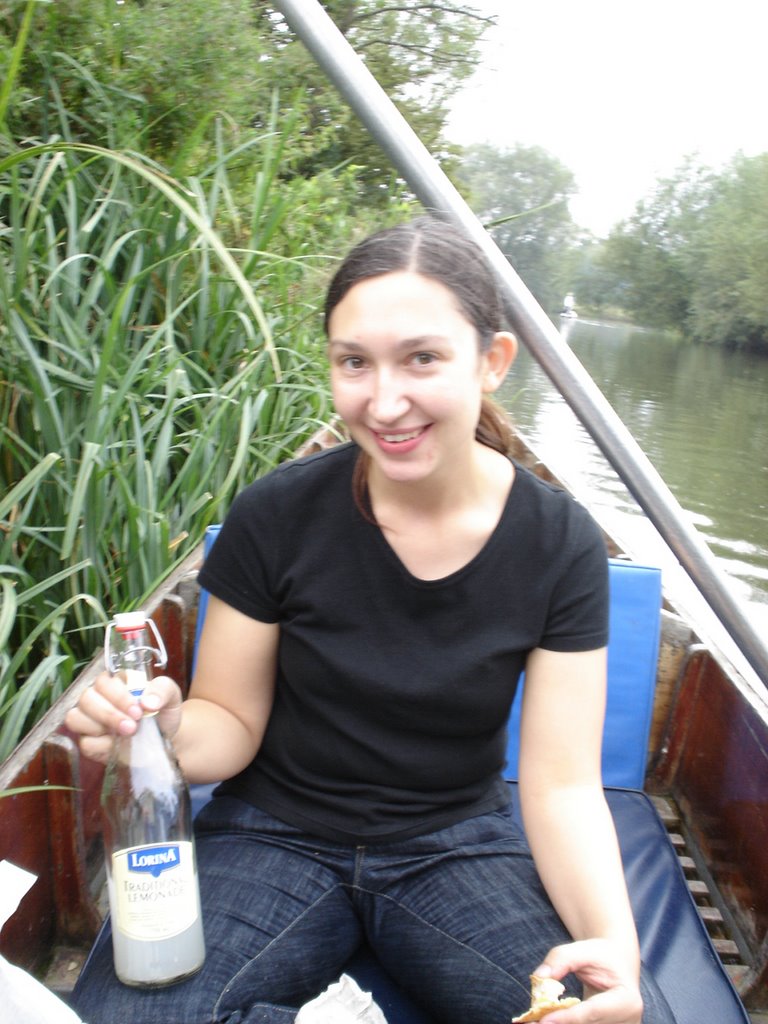
Katy in a punt. Katy and I were celebrating multiple happy occasions this trip: her engagement; my 28th birthday; the completion of her dissertation; and our ten-year anniversary of being best friends. On Saturday, Katy took me out for a picnic in a punt: a baguette, sharp cheddar, tart apples, Cornish pasties, McVitie's, dark chocolate pastilles, water and lemonade (which I insisted on having in honor of Lord Peter and Harriet, though ours was non-synthetic). Katy did all the punting, while I sat and watched the ducks and the undergraduates float by, and we talked and talked and talked. We went up the Cherwell to a pub called the Victoria Arms, where we each had a glass of Pimm's, then came back down for dinner with her fiance Josh and a wonderful bonfire with McVitie's s'mores. (Directions: 1. Toast one marshmallow to the bursting point. 2. Quickly remove the marshmallow from the stick and place it on a chocolate-side-up McVitie. 3. Place another McVitie on top, chocolate side down, and squash to make the chocolate melt. 4. Eat quickly, and don't be ashamed to lick your fingers.)


Me on a stile. On Sunday, Katy and I journeyed by train and bus up to the Peak District in Derbyshire. We held my official birthday dinner at the Rutland Arms Hotel in Bakewell (an inn where Jane Austen herself stayed during a visit to the county in 1811) and slept that night in a B&B. The next day, we set off on a five-mile trek over the Dales, which occasioned considerable good-natured sisterly bickering over the map (Katy held it), our route (I didn't trust her), if it would rain (it didn't), and whether we would reach our destination in time for afternoon tea (of paramount concern to both of us). As it turned out, I was right that our route was not the one marked on the map, but we agreed that the map was stupid and our way was better, as we saw a great deal of beautiful Derbyshire countryside (and sheep) and still reached Chatsworth by 1 p.m. -- plenty of time for tea.

Chatsworth. Why were we so wild to see Chatsworth, you ask? Because Jane Austen likewise visited it on that 1811 trip, right when she was revising Pride and Prejudice, and it is very likely the model for Pemberley:

They gradually ascended for half a mile, and then found themselves at the top of a considerable eminence, where the wood ceased, and the eye was instantly caught by Pemberley House, situated on the opposite side of a valley, into which the road, with some abruptness, wound. It was a large, handsome, stone building, standing well on rising ground, and backed by a ridge of high woody hills; -- and in front, a stream of some natural importance was swelled into greater, but without any artificial appearance. . . . Elizabeth was delighted.

And it is lovely. Begun in 1552 by Bess Hardwick and her second husband William Cavendish, it housed Mary Queen of Scots at various times during her imprisonment, and it is still the home of the Cavendish family -- better known as the Duke and Duchess of Devonshire. The interiors were gorgeous and luxurious without gratuitous ostentation, and the grounds (originally designed by Capability Brown) included a cascade, a rose garden, a delightful hedge maze (which pleased me very much, as I long ago wrote a P&P fanfic set in a hedge maze at Pemberley), and a Squirting Willow (no doubt cousin to the Whomping variety up north). And the stables have been converted into a restaurant, where we had our delicious, much-anticipated tea.

Mr. Darcy, the statue. In fact, Chatsworth is so lovely and so what Jane Austen had in mind that its exterior, entrance hall, and sculpture gallery served as Pemberley in the 2005 adaptation of P&P. While I have considerable differences with that adaptation, I was very fond of Matthew MacFadyen, and they've kept the plaster bust of him as Mr. Darcy in the sculpture gallery where Keira Knightley-as-Elizabeth sees it in the film. It's displayed next to the dress Keira wore in that scene and real first editions of P&P, Sense and Sensibility, and Northanger Abbey/Persuasion, which I did not steal, despite my extreme case of book lust. Future visitors to Chatsworth may thank me for my forebearance.


Decadence. Finally, of course, after we came back to Oxford on Tuesday, we had to rent the execrable new P&P and watch it all over again -- which was actually a pleasure, as we'd never seen and snarked at it together. So here we have from right to left: the movie; a glass of Cava sparkling wine; Nutella; strawberries; McVitie's; more wine; and Ben & Jerry's Phish Food. Bliss.

More pictures of our trip, with commentary, are now up on my Flickr page here.

Wednesday, January 18, 2006

Interview and Apartment Art

There is a very, very kind interview with me on the SCBWI website here.

If you read it, or if you're finding this blog from it, the subway-card butterflies are worth explaining in more detail. Lori asked me if I had any hobbies, and I said yes, I like to make art out of subway fare cards, which in NYC are called MetroCards. MetroCards are made from a thin, flexible plastic that keeps its shape if you bend it -- I make the butterflies by folding the cards in half and cutting out a butterfly wing from the fold, then balancing the butterfly on the fold with tape. There are six of them (plus a dragonfly) perched around my apartment, and they really do look like they could take off any moment. . . .

As for the mural, I missed trees after I moved to New York, so I bought green and brown paper at a nearby stationery store and created my own forest on the wall of my studio apartment. (This picture was taken on a day when I was having my book group over for dinner, hence the highly unusual neatness.) I love Henri Matisse, and the far tree on the left is made from cut-paper shapes like the collages he created at the end of his life -- I'd love to redo the whole mural this way (it's nearly four years old now), but I haven't had time to work on it. (In passing, many, many manuscripts have been edited or read in that big yellow chair.) There's a bright red kite with a MetroCard star on the next tree from the left; a bird cut from a NYC subway map on the rectangular tree in the middle; Shakespeare's Sonnet 116 nailed to the trunk of the next tree over, inspired by "As You Like It" (though I replace it with "Since there's no help" when I'm feeling romantically depressed); and an origami cicada and a MetroCard canary on the tree on the right. And then there are paper and MetroCard flowers, apples, vines, stars, even a snake (because this is a garden) in odd and unexpected places around the rest of the apartment. The installation as a whole is called "Brooklyn Arden," whence also the name of this blog.

This is what I said to Lori about it: "The artwork in my apartment is all intuitive, but there ends up being a kind of rhythm and balance to it -- I have stars here so I need flowers there, MetroCards here so I need paper there -- in much the same way I try to figure out a manuscript's rhythm and balance, I'll say, to bring this back to editing. This will sound completely cheesy, but in both things I want to have beauty and life and joy." And it's true.

Sunday, September 18, 2005

News 'n' Notes

  • There's still time to join the Carleton Race for the Cure team or contribute to my personal fundraising goal. Thank you very much to all who give or participate.
  • I will be speaking at the Rocky Mountain SCBWI fall conference October 8-9, and they interviewed me in conjunction with that here. My talk that Sunday is called "The Rules of Engagement: How to Get (and Keep!) a Reader Involved with Your Novel," and while I've been thinking about this vaguely for months, at the moment I'm feeling that inchoate panic that all writers feel facing the blank page, especially when there's a deadline ahead. Aya. Well, it'll get done.
  • While I'm in Colorado, I'll be missing Open House New York, an awesome event that opens various houses, monuments, museums, and other architecturally interesting structures to the general public for tours and education. Two years ago I climbed to the top of the Jefferson Market Library tower in the West Village and the top of the Highbridge water tower in Washington Heights as part of OHNY, and last year Rachel and I ventured to the top of the memorial at Grand Army Plaza, which offered a fantastic view over Prospect Park and Brooklyn. This year's site list will be announced Sept. 21. Go, people! It's completely cool.
  • Speaking of cool New York things to do, I went kayaking in the Hudson yesterday as part of my Resolutions. It was a gray, windy morning, hovering on the edge of rain, and when I arrived at the Downtown Boathouse, I was one of only two people there. The other woman showed me how to paddle and set me in an open-top kayak off the pier, and it was completely lovely: easy, swift, rhythmic and meditative, with the city behind me, the gray vistas of Jersey City across the river, the sun skimming sleepily through the clouds, and the swells and my own strength carrying me along. Forty minutes passed; it felt like ten, and I definitely want to go again. Free walk-up kayaking is available at Pier 26 every weekend through October 15.
  • Then today, also as part of my Resolutions, I went to Montauk Point. A slight planning snafu meant that I ended up walking about nine miles instead of six or seven (I, um, failed to look at a map, so I set off on the wrong road and had to get directions from a kindly biker, deli store clerk, and marina lady), but it was a beautiful day to be wandering through the countryside, and I felt a huge rush of satisfaction and accomplishment as I came over the last hill to the lighthouse. After I climbed to the top of the tower, I rested on the little beach you can see on the website picture for an hour or so, then caught a taxi back to the train station and came home. I think I am now one of the very few people in the world who can say they have been to both the southwesternmost and northeasternmost tips of Long Island. (I imagine I am also one of the very few people who care.)
  • Happy belated birthday to my sister Melissa, who turned 21 on September 15. Yay kid! You're legal at last!
  • Because a few people have asked: Chavelaque (pronounced shah-vey-la kay) is a construction that I made up in college, a sort of bilingual pun on "Cheryl K": "Chavela" was my name in high-school Spanish class, which a few friends adopted as a pet name, and "que" in Spanish means "What?", the randomness of which appealed to me. And this blog is called "Brooklyn Arden" because I live in Brooklyn and "As You Like It" is my favorite Shakespeare play.
  • Technical questions: Can someone tell me how to do cut tags, please? Particularly to pictures? (And then can the pictures just be on my hard drive, or do I have to upload them to Flickr or something? I have Picasa, will that do?) And also, do the labels in gmail actually do anything or are they just pretty little green words next to certain conversations?
  • I recently cooked this fantastic Curried Peach Pork for Katy. Right now is the time to get fresh peaches, and like Cranberry Chicken, this is excellent served over white rice with white wine.
  • In return for this fabulous dinner, what did Katy give me? A Bible Bar, which boasts on the label, "Nutrition God's Way!" I'm sorry to report that I found it a little too sickly sweet and sticky to be fully satisfying tastewise, but apparently it's quite healthful both physically and spiritually. ("All Things Considered" did a story on these once.) Check out the entire list of Foods of the Bible here.
  • Just finished Idoru by William Gibson and started an absolutely delicious bonkbuster called Riders. (Rachel lent me her British edition, which has the trashiest cover ever; there is no redeeming literary value to it whatsoever, but my lord, I'm enjoying this book.) I need to get back into Midnight's Children or The Brothers Karamazov for my Resolutions, and read Meg Cabot's Ready or Not for my YA book club. After that: V for Vendetta; 13 Little Blue Envelopes; and Diana Abu-Jaber's The Language of Baklava.
  • I think that's all for now. Hope all's well with all of you!

Thursday, August 04, 2005

Letter to a Young Aspiring Editor

One of the students I spoke to yesterday wrote to me today and asked a few more questions about the editorial life. I thought my replies might interest some of you here, so:

DPI Student: Do you feel that being an editor has given you insight into what it takes to get a book published? Do you feel like you have a better chance, or at least a better idea, about what it would take for you to write a book that would get published if you ever wanted to write a book? I know that's kind of a weird question, but I've always been curious about whether or not editors feel this way. I was surprised to hear Gladys and Arnold [the teachers of the editorial workshop at DPI] say that most good editors do not make good writers because I thought that being a good editor would help you be a good writer. What do you think about this?

CK: Yes, absolutely I feel that being an editor has given me insight into the publication process, how to write up a query letter, who to send a book to, etc. I toy with the idea of writing myself -- one of my New Year's Resolutions is to "Write a bad novel" -- and if I do finally get around to it, the editing experience has taught me what agent I'd want to go with (if I went with an agent), what editors I'd want the book to go to, what kind of terms I'd expect for my work, what subrights I'd hold out for, etc., based on my experience of how the business works. And I also know plenty about the principles of good fiction (which is where my brain goes when I think of "writing"): how stories operate, how to set up mysteries, what my characters need to do in order to be likable. So I know the mechanics of writing good fiction, and I definitely know the mechanics of getting it published.

HOWEVER, this does NOT mean that I can actually write good fiction. Partly this is because I'm so hyperaware of the mechanics of good fiction that I'm incredibly easily dissatisfied and I quit when things aren't going well, and if there's one thing a writer needs more than anything else, it's perseverance. Partly it's because I don't have the time and attention to devote to it that a fiction writer really needs -- I have too many responsibilities to my authors under contract and the ones who submit work to me to use my limited free time to indulge my own writing tastes. You will note that my Resolution is to "Write a *bad* novel" -- I felt if I gave myself permission to have the first draft of the book be crappy, I might get the thing done. Thus far, though I have ideas, very little has been accomplished.

Good editors are often terrific writers of things other than fiction, I should note -- we write flap copy, we write sales letters, we write catalog copy, and all of that is *good* writing in the sense that it sounds good, it means something, and it accomplishes the purpose it's meant to (persuade someone to buy/pay attention to the book). And many editors are successful writers as well -- see Jill Bialosky (Norton), Michael Korda (S&S), Ursula Nordstrom (legendary Harper children's books editor -- read her collection of letters, DEAR GENIUS, if you're at all interested in going into children's books. But note that she threw the sequel to her first novel into a fire because she was dissatisfied with it.). Arthur, my boss, writes picture books and gets them published. But as a rule, editors exist to serve writers and make books, not to write them ourselves, and I'm always an editor first.

DPIS: Do you feel that you get to be creative as an editor? You mentioned that you feel proud when a book you edited has been completed because you played such a huge role in putting the book together, which I found fascinating. Why don't editors get to share in the profits of book sales, especially if the sales are really good?

CK: To address your second question first: Editors don't get to share in the profits of book sales if the sales are good because that would also require us to share in the profits if sales were bad. That is, tying book sales to editorial salaries would have to be done across the board, and editors don't want to risk their own salaries on the chance that a book will tank. (Such a practice would also make editors less likely to buy risky books, and the business would stagnate.) Editors who have notable successes usually get promoted and get more freedom to publish the kind of books they want to publish, which is the way we share in a book's profits. Arthur got to establish his own imprint at Scholastic after he'd discovered REDWALL for Philomel, made a success out of THE GOLDEN COMPASS at Knopf, and won two Caldecott Medals at Putnam -- and that resume led the higher-ups at Scholastic to have faith in him when he wanted to purchase a little British fantasy called HARRY POTTER AND THE PHILOSOPHER'S STONE. And the rest is history.

And your second question -- yes, absolutely, I think we get to be creative. I spoke a little about "vision" yesterday, and that's because from the very first moment I read a manuscript, I develop two visions of it. The first is the editorial vision: I try to figure out what the author is trying to do in the book and how I can help him/her better accomplish that, and all of our conversations and all of my editing after that point will be dedicated to that pursuit, making the book all it can be. Second, I develop a publication vision: How the book should look, how it can be marketed, what kind of audience it would appeal to, how we can reach that market, and all of my efforts for the book not in conjunction with the author are dedicated to that end.

A good example of this is a book I recently edited called THE LEGEND OF THE WANDERING KING (in stores now!). It's a translation of a Spanish fantasy about a prince of pre-Islamic Arabia who commits a terrible crime in his youth (the first half of the book), and spends the second half of the book trying to make up for it and to find an enchanted carpet involved in the crime. (It's an amazing book, if I do say so myself.) I worked with the author to make the ending (and therefore the meaning) of the book more clear and comprehensible to readers and to tighten some loose writing throughout. That was serving the editorial vision.

And then, for the publication vision, I sat down with our book designer to talk over the book and its potential appearance. It has aspects of inspirational fiction a la Paulo Coelho (a hero of the author's), and potential to reach the adult market, so we very consciously modeled our book jacket after the style of Paulo Coelho's books. (You can see a picture of it and the catalog copy here: http://www.arthuralevinebooks.com/book.asp?bookid=89). It follows a quest across Arabia, so I put money in the book's budget for an artist to draw a map of Arabia to use as a frontispiece and as an aid to readers, and I researched Arabia circa 560 CE so the map could be as accurate as possible. It's inspired by a true story, so I worked with Laura on her author's note to more clearly delineate the line between fact and fiction (very important to reviewers in the library market) and to add some great new information about the real-life model for the protagonist that I uncovered in researching him. And it uses Arabic terms throughout, so I compiled a glossary and pronunciation guide with the help of professors at Harvard and NYU and a friend of mine who studies Arabic. I wrote letters to potential blurbers; I wrote letters to our sales reps to inspire them to read the book; I sent galleys of the book to Arabic community centers throughout the United States, hoping to stir up interest in the Arab community, as there hasn't been much fiction for teenagers featuring Arab characters. (You can read more about my work on and love for the book here: http://www.arthuralevinebooks.com/blog.asp. This also includes some personal reflections on the book in relation to my time at DPI, oddly enough.) It took a lot of creativity to put all that together -- again, if I do say so myself -- and I am very, very proud of the final product, both its content and its appearance.